Start of heading level 1: Messier 31: Andromeda Galaxy in Mosaic Mode End of heading.

Astrophotography from home sometimes calls for creative solutions. Although I have a garden and yard available, setting up valuable equipment outside unattended for several hours overnight always carries a risk of theft. Observing directly through a roof window is significantly safer in that regard.

To position the Seestar S30 Pro stably, securely, and gently at the roof window, I built a custom mounting rig—a “table” without a tabletop:

  • Material & Profile: The frame is constructed from 20 × 20 mm aluminum extrusion profiles (Slot 6 / Nut 6). (Note: Unfortunately, no photograph of this rig is currently available.)
  • Variable Leg Lengths: The “table” features legs of different lengths to perfectly compensate for the geometry and pitch of the roof slope.
  • The Roof Window “Claw”: Two 10 cm long legs function as a claw/hook mechanism, allowing the rig to latch securely onto the roof window frame and stay firmly in place.
  • DIY Frame Protection: To protect the window frame from scratches caused by the aluminum profiles, each claw leg is carefully padded: wrapped first in an old cloth handkerchief and then covered with an old sock.
  • Telescope Mount: An adapter translating from an M6 bolt to a standard 3/8-inch tripod thread is attached to one upper edge. The Seestar S30 Pro mounts solidly onto this 3/8" thread. (A humorous shout-out goes to audio equipment manufacturers here: without stage and microphone gear producers, we probably wouldn’t have such handy M6-to-camera-thread adapters!)

Thanks to this DIY mount, the smart telescope can be operated conveniently, securely, and without damaging the window frame. It was with this exact setup during the night of July 25–26, 2026, that I captured an impressive mosaic of our neighboring galaxy, the Andromeda Galaxy (Messier 31).

Start of heading level 2: Setup & Compass Reboot End of heading.

As noted in my previous solar observation review, the Seestar’s internal compass can occasionally misalign on the very first slew of a session. Before targeting M31, I initially slewed to the Moon. Sure enough, the compass pointing was off on the first attempt.

A quick reboot of the telescope solved the issue immediately. Following the restart, celestial positioning was spot-on as usual. (You can check out the resulting Moon capture on AstroImg).

Start of heading level 2: Mosaic Framing in the Seestar App End of heading.

Setting up the framing for the Andromeda Galaxy in the Seestar app was remarkably smooth. Dragging across the interactive star map, along with rotating and zooming within the Framing menu, makes framing large targets intuitive and accurate.

Because M31 spans over 3° across the sky, it is far too large for the telescope’s native field of view. Using Mosaic Mode expanded the FOV to approximately 3.8° × 2.2°, providing ample space to frame the entire galaxy along with its companion objects.

Start of heading level 3: Filter Selection: IRCUT vs. LP End of heading.

I deliberately chose the internal IRCUT filter over the LP (Light Pollution / dual-band) filter. Galaxies are broadband continuum emitters that radiate across the entire optical spectrum; using a light pollution filter would cut out too much of the galaxy’s natural starlight.

Start of heading level 2: Observing Conditions & Battery Performance End of heading.

The conditions during this summer night were excellent:

  • Location & Sky: Observed from a village location rated at Bortle 4.7. No clouds were present—neither visually to the naked eye nor on DWD satellite weather maps.
  • Temperature & Sensor: Ambient temperature was 12 °C (dew point 10 °C). Due to high humidity, I enabled the internal dew heater for the final 30–40 minutes of the session. Sensor temperature fluctuated between 27.5 °C and 29 °C.
  • Capture Timestamp: The final stacked mosaic exposure was completed early in the morning on July 26, 2026 at 03:23 AM (CEST).
  • Battery Endurance: The entire session ran on internal battery power without an external power bank. Across nearly 81 minutes of continuous exposure (485 × 10 s sub-frames) plus dew heating, the battery performed admirably, finishing with 25% remaining capacity.

Start of heading level 2: Thermal Behavior at the Roof Window End of heading.

It is often claimed that observing through an open roof window causes severe turbulence due to warm indoor air or heat radiating from roof tiles. In practice: No negative impacts from thermal currents or airflow were noticeable. The Seestar stacked frames without any trouble.

Start of heading level 2: The Result: Messier 31 End of heading.

Here is the final stacked image from 485 individual sub-frames (Total exposure time: 4,850 seconds / ~80 min 50 sec):
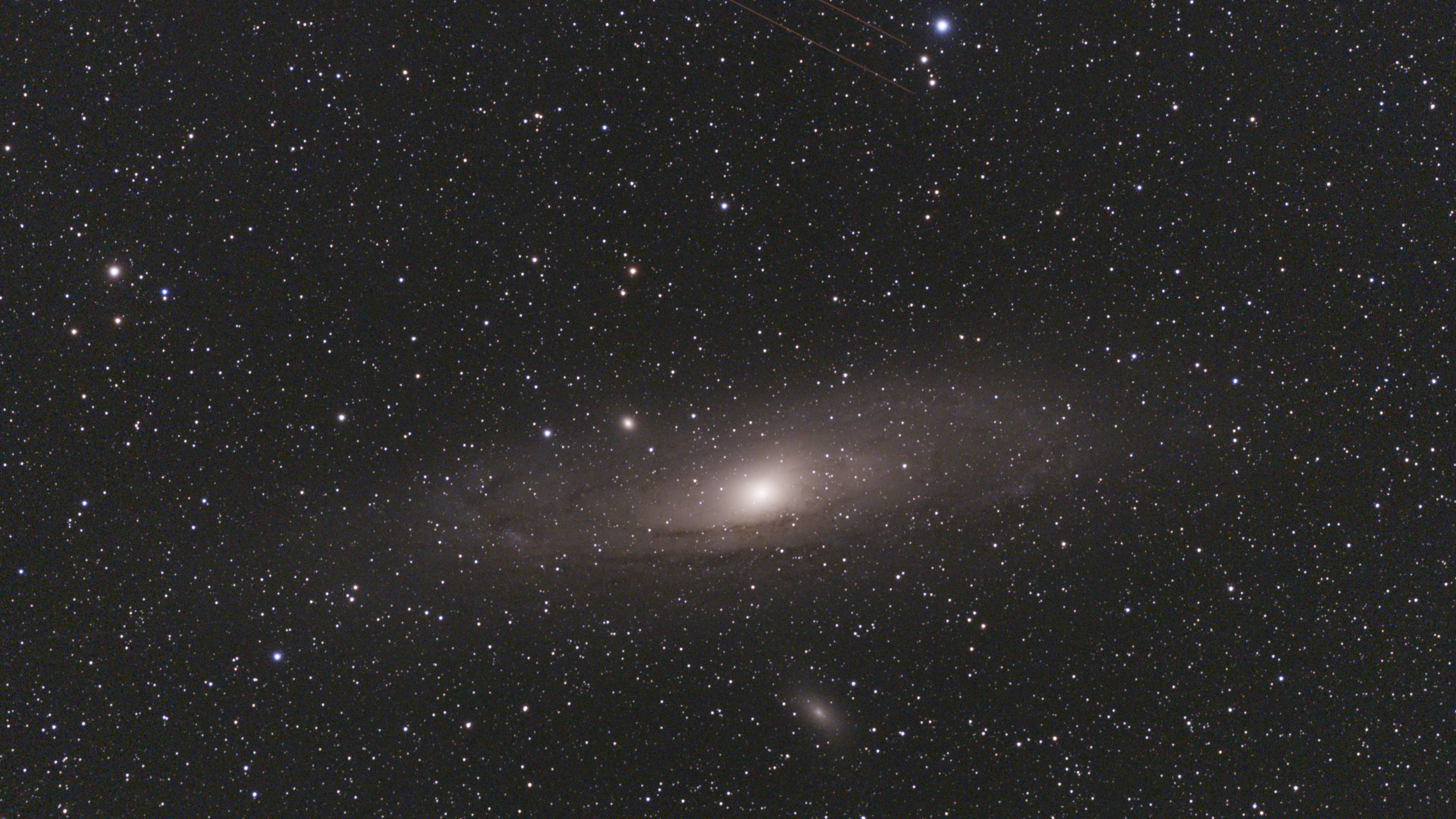
Messier 31 Andromeda Galaxy Mosaic ZWO Seestar S30 Pro

Start of heading level 3: Identified Celestial Objects: End of heading.

  • M31 (NGC 224): Andromeda Galaxy with its bright nucleus and intricate dust lanes.
  • M32 (NGC 221): Elliptical dwarf galaxy (south of the M31 core).
  • M110 (NGC 205): Elliptical dwarf galaxy (northwest of M31).
  • NGC 206: Massive star-forming region / H-II complex in M31’s spiral arm.
  • Foreground Stars: ν Andromedae (ν And, Mag ~4.5) as well as 32 & 39 Andromedae.

Image note: Near the top edge, two faint parallel lines are visible—likely caused by a satellite or aircraft passing through the field of view during the session.


Start of heading level 2: Interactive FITS Viewer End of heading.

You can inspect the raw FITS header and WCS coordinates (Image center RA 11.222°, DEC 40.650°) directly using the interactive viewer below:

[guest@do3eet /var/www]# fitsview Stacked_485_mosaic_M%2031_10.0s_IRCUT_20260726-032328.fit
Loading FITS file...
--rgb
--red
--green
--blue

ASTRONOMISCHES OBJEKT Loading...

Teleskop -
Filter -
Belichtungszeit -
Gestackte Bilder -
Gain -
Kameratemp. -
Aufnahmezeit (UTC) -
Rektaszension / Deklination (WCS) -
Brightness (Helligkeit) 1.0
Contrast (Schwarzpunkt) 0.0
Gamma / Midtones 1.00

Start of heading level 2: What should I photograph next? End of heading.

The Seestar S30 Pro performed exceptionally well in Mosaic Mode mounted on the DIY roof window rig. Now I’d love to hear from you: Which deep-sky target should I aim for next in Mosaic Mode? Share your suggestions!

×
Achievement Unlocked

Lang verschollenen Tux gefunden
Der Geist der CLT2026 lebt! 🐧✨

Ich bin Frank. Ein Informatiker und Funkamateur aus Deutschland. Außerdem reise ich gern nach Japan.


By Frank Tornack, 2026-07-27

×
Achievement Unlocked

Screen Burn-In
Glückwunsch! Deine Pixel sind jetzt offiziell eins mit meiner Website. 📺✨